The mind is not the brain
The brain is a physical object. Roughly 1.4 kilograms, sitting inside your skull, made of tissue you could hold in your hand. It can be scanned, weighed, injured and operated on.
The mind cannot. Nobody has ever held one, photographed one, or put one on a table. And yet we talk about the two as though they are the same thing, and in workplaces that confusion causes real problems.
A working metaphor
The way I describe it is that the brain is the engine and the mind is the operating system. The engine is hardware. The operating system is what runs on it: how information is interpreted, what gets attention, what meaning is assigned.
I should be honest that this is a working metaphor I have adopted to explain a complex part of being human, rather than a settled scientific position. The relationship between mind and brain is genuinely contested territory, philosophers have argued about it for centuries, and anyone who tells you it is resolved is overstating. But as a way of thinking about what is changeable, it has been useful with clients over the years. Too useful not to share more broadly.
An operating system needs something to run
Here is the part I usually have to add, because the metaphor is incomplete without it.
An operating system does not sit there processing itself. It runs on inputs. Information arrives, and the system interprets it, assigns meaning to it, and produces a response.
So there are three things in play. The hardware, which is the brain. The operating system, which is the mind. And the inputs, which at work are supplied almost entirely by the organisation and the people running it.
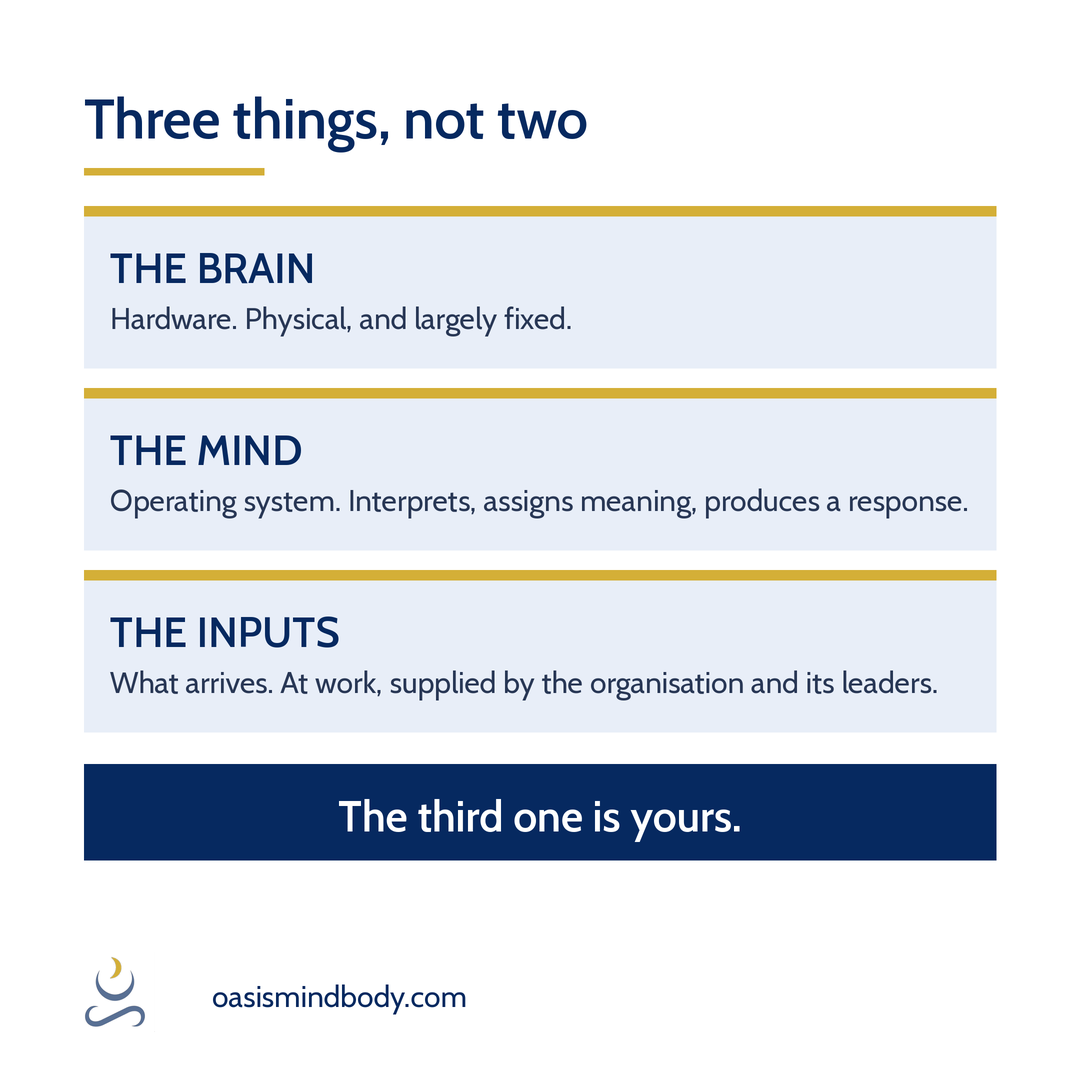
That third element is where this stops being an interesting distinction and starts being a leadership question.
Why the distinction matters at work
Consider two people receiving the same restructure announcement in the same meeting.
One hears an opportunity. The other hears a threat to their mortgage. Same information, same room. The difference is not in their brains in any meaningful sense. Both had an automatic response. What differs is everything layered on top of it: prior experience, what they believe about their standing, what they have been told, and what the organisation's track record leads them to expect.
Two of those are personal history and outside your reach. Two of them, what people have been told and what your track record has taught them, were supplied by the organisation. Those are inputs, and inputs can be changed.
What the science supports, and what it does not
There is decent evidence that deliberate cognitive processes can modulate automatic emotional responses. How a situation is interpreted affects the intensity and duration of the response to it, and that interpretation can be influenced. This is well-established territory in psychological research and it underpins a good deal of evidence-based practice.
What the evidence does not support is the version that turns up in wellbeing content, where the brain is shown as endlessly reprogrammable and the implication is that anyone still struggling has not tried hard enough.
Brains do change. They change through repeated experience over time, with consistent exposure, and they change in response to environment. They do not change because someone attended a lunchtime session on neuroplasticity.
The part leaders can actually influence
You cannot reach inside someone and adjust their hardware. That is not the job and it never was.
But you are supplying the inputs, and more of them than most leaders realise. A global study by The Workforce Institute at UKG, which surveyed 3,400 people across ten countries in 2023, found that employees said their manager affects their mental health just as much as their spouse or partner (69%) (UKG, 2025).
That is self-reported perception rather than measured causation. However, as a description of how much of the working environment a manager occupies in someone's experience, it is hard to ignore.
So: whether expectations are clear or ambiguous. Whether change is explained or announced. Whether raising a problem has historically been rewarded or quietly punished. Whether people have any say over how the work gets done.
None of that is neurology. All of it is input, and all of it shapes the interpretation, and therefore the response.
Which reframes the leadership task usefully. You are not being asked to fix anyone. You are being asked to notice that you are a significant part of what people are processing, and to be deliberate about what you are supplying.
Worth asking
1. When we communicate a change, are we supplying information or leaving people to fill the gaps themselves? The gaps get filled either way.
2. What has our track record taught people to expect when they raise something difficult?
3. Where we have invested in resilience or mindset training, have we also changed anything about the environment people are interpreting?
4. If two people on the same team respond very differently to the same event, are we curious about why, or do we conclude that one of them is difficult?
The point
The brain is hardware, and it is not going to change much this quarter. The mind is the operating system, and it belongs to the person, not to you.
The inputs are yours. What people are told, what they are asked to absorb, and what the organisation has taught them to expect. That is the layer you control, and it could change by Monday.
The most useful thing about separating the three is that it changes the question. Not who is resilient, but what we are asking people to manage.
Stay Curious,
Genevieve
This distinction sits underneath everything in The Psychologically Safe Leader. Opening for pre-sale shortly. Be the first to know.
This article is general information about work design and leadership capability. It is not legal advice, work health and safety advice, or clinical advice.