The hazards most leaders cannot name
Ask a manager to name the hazards in their workplace and you will usually get a decent list. Trips, lifting, machinery, vehicles, chemicals if the work involves them. Ask the same manager to name the psychosocial hazards and the list gets very short, fast. Bullying. Stress. Maybe workload.
Australia's model Code of Practice on managing psychosocial hazards at work identifies far more than that. Depending on how they are grouped and which jurisdiction you are in, the number usually quoted is seventeen.
That gap between three and seventeen is not a trivia problem. It is a control problem, because you cannot manage a hazard you have not identified.
What a psychosocial hazard actually is
The definition is broader than most people expect. A psychosocial hazard is an aspect of the work, the work design, or the work environment that has the potential to cause psychological or physical harm. Not a person. Not a diagnosis. An aspect of the work.
The mechanism is stress. Most of these things are ordinary features of working life in small doses, and the same feature becomes a hazard when exposure is severe, prolonged or frequent. A tight deadline is not a hazard. Eighteen months of tight deadlines with no let-up is a different proposition entirely.
The list, in plain language
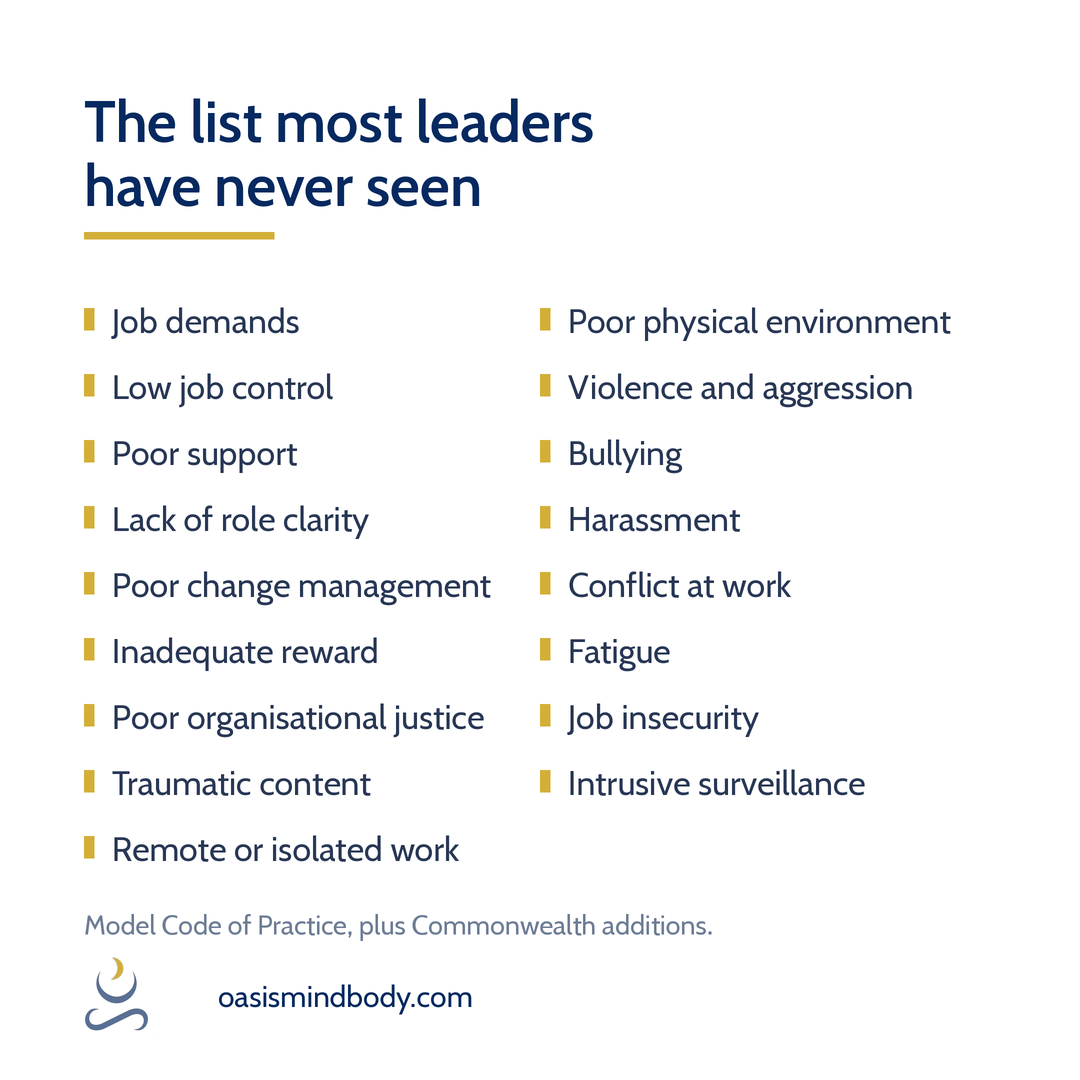
Grouped loosely, the hazards named in the model Code cover:
• Job demands, both too high and too low, including time pressure and emotional demands
• Low job control, where people have little say over how or when the work is done
• Poor support, whether that is inadequate resourcing, tools, or a manager who is not there
• Lack of role clarity, where expectations are unclear or actively conflict
• Poor organisational change management, which is where most restructures land
• Inadequate reward and recognition
• Poor organisational justice, meaning inconsistency, unfairness, or a process nobody trusts
• Traumatic events or material, including repeated exposure to distressing content
• Remote or isolated work
• Poor physical environment
• Violence and aggression, including from customers and members of the public
• Bullying
• Harassment, including sexual harassment
• Conflict or poor workplace relationships and interactions
The Commonwealth version goes further again, adding fatigue, job insecurity, and intrusive surveillance, which between them describe a great deal of modern working life.
Safe Work Australia publishes definitions and examples for each of these hazards.
Hazards do not queue politely
The Code is explicit that these things interact, and this is the part most risk assessments miss.
A person managing high job demands may be perfectly fine. Add low job control, so they cannot decide how or when to do the work. Add poor support, so there is nobody to escalate to. Add a restructure nobody has explained. Each one might have been survivable alone. Together they produce a level of risk considerably greater than any of them separately.
Which means a tick-box audit that assesses each hazard in isolation and finds everything within tolerance can still be describing a workplace that is genuinely unsafe.
What the Code asks of leaders
The duty is not to be nice about it. Under WHS law a business must eliminate psychosocial risks so far as is reasonably practicable, and where elimination is not reasonably practicable, minimise them so far as is reasonably practicable.
That word elimination matters, because it points at design. The Code is clear that the highest-order response is to change the work: how it is structured, resourced, sequenced and governed. Lower-order responses come after, not instead. Support belongs in the system. It does not substitute for the design work above it.
This is the part worth reading twice if you have ever answered a psychological health question with your EAP. Regulators have been explicit that training and employee assistance programs sit at the lower end of the control hierarchy, and that they cannot be the primary or dominant control measure. Some have said so explicitly. That is not a criticism of either, it is a statement about sequence.
If you are reading this outside Australia
The specifics above are Australian, and the model Code only has legal force in a jurisdiction that has adopted it, so it is worth checking what applies where you are.
The underlying idea is not uniquely Australian. ISO 45003, the international standard for psychological health and safety at work, covers substantially the same territory, and regulators across a number of countries have been moving in the same direction for several years. The vocabulary may differ. The proposition does not: the way work is designed creates or reduces psychological risk, and that is an organisational responsibility rather than an individual one.
Worth asking
1. How many of these hazards could our leaders name without looking? If the honest answer is three, that is our starting point.
2. Which of them are present in our workplace right now, and how would we know? Naming them is the step most organisations skip.
3. Where hazards overlap in the same team, are we assessing them together or one at a time?
4. When we last responded to a psychosocial risk, did we change the work, or did we offer support and leave the work alone?
5. When did we last review the controls we have in place? Identifying hazards is not a set and forget exercise.
The point
Most organisations are not indifferent to psychosocial risk. They are working from a much shorter list than the one that exists, which means large parts of the work go unexamined simply because nobody has named them as hazards.
The list is the cheapest possible starting point. It costs nothing to read, and it makes visible a set of things that were always there.
Stay Curious,
Genevieve
Understanding the hazards is step one. Building the leadership capability to respond is the harder part.
Be the first to know when we launch. Join the Academy waitlist →
This article is general information about work design and leadership capability. It is not legal advice, work health and safety advice, or clinical advice.