Most of your people are at the wide end. Most of your spend is at the point.
Last week I wrote that an Employee Assistance Program is three things, and that most organisations have bought one of them. This week I explore why the shape of that matters more than the list.
The Cone of Health™
I have been using a cone to describe psychological health at work for some time now, because a list of EAP elements does not tell you anything about size, and size is the whole argument.
Prevention and training sits at the top, and it is the widest band. Training, education, leader capability, the things that build understanding across an organisation before anyone needs help.
Early intervention sits below it, narrower. Noticing, responding, and supporting someone before things reach crisis.
Recovery is the point at the bottom. Return to work, rebuilding, coming back to full functioning.
And the whole thing rests on a base, which is psychological safety. Not a fourth tier but the surface everything else stands on. Take it away and the cone has nothing to sit on: people will not raise something early, will not use the support that exists, and will not tell you the truth about how the work is going.
The width is what matters. At any given moment, most of your workforce is in the top band. A smaller group needs early intervention. A smaller group again is in recovery. That is not a failure of the organisation, it is just how most populations distribute.
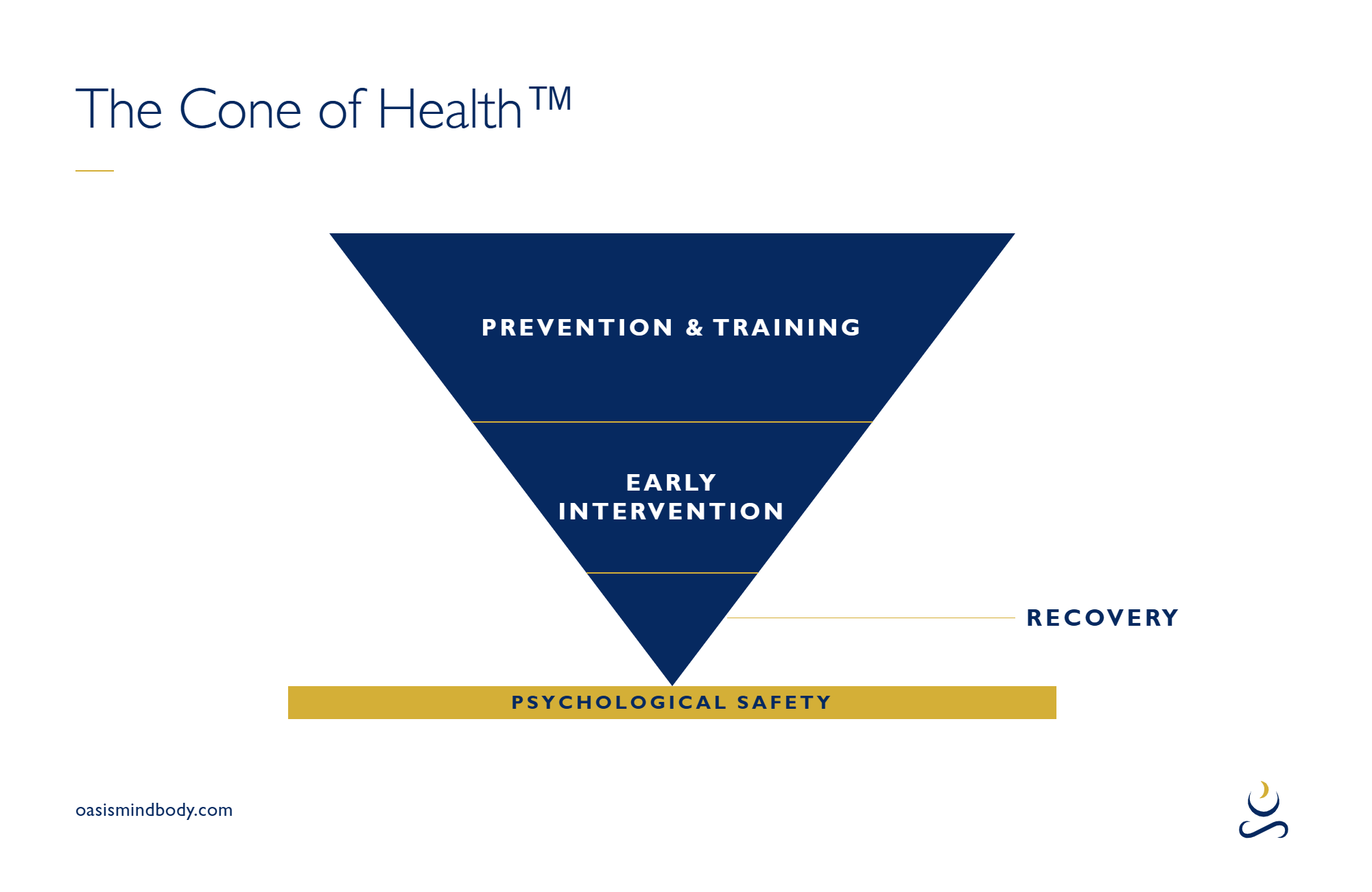
Diagram of the Cone of Health, showing prevention and training as the widest band at the top, narrowing through early intervention to recovery at the point, resting on a base labelled psychological safety.
Now turn it upside down
Draw a second cone next to the first, pointing the other way, and you have the cost.
Cost per person is lowest at the top. A workshop delivered to a team, an education session, a manager who has been given language for a conversation: those costs spread across many people and stay modest. Move down and the cost per person climbs. Counselling is one person at a time. Move further down and it climbs again: a psychological injury claim, extended leave, backfill, recruitment if the person does not come back, the institutional knowledge that leaves with them, and the effect on the team that watched it happen.
So you have two cones on the same axis, pointing in opposite directions. People are widest at the top. Cost is widest at the bottom.
Which raises the question worth sitting with. Which shape does your investment look like?
In my experience it usually looks like the second one. Money, attention and reporting concentrate at the narrow end, where the fewest people are and where the harm has already happened. The wide band at the top, where almost everyone is, gets the induction slide and the poster.
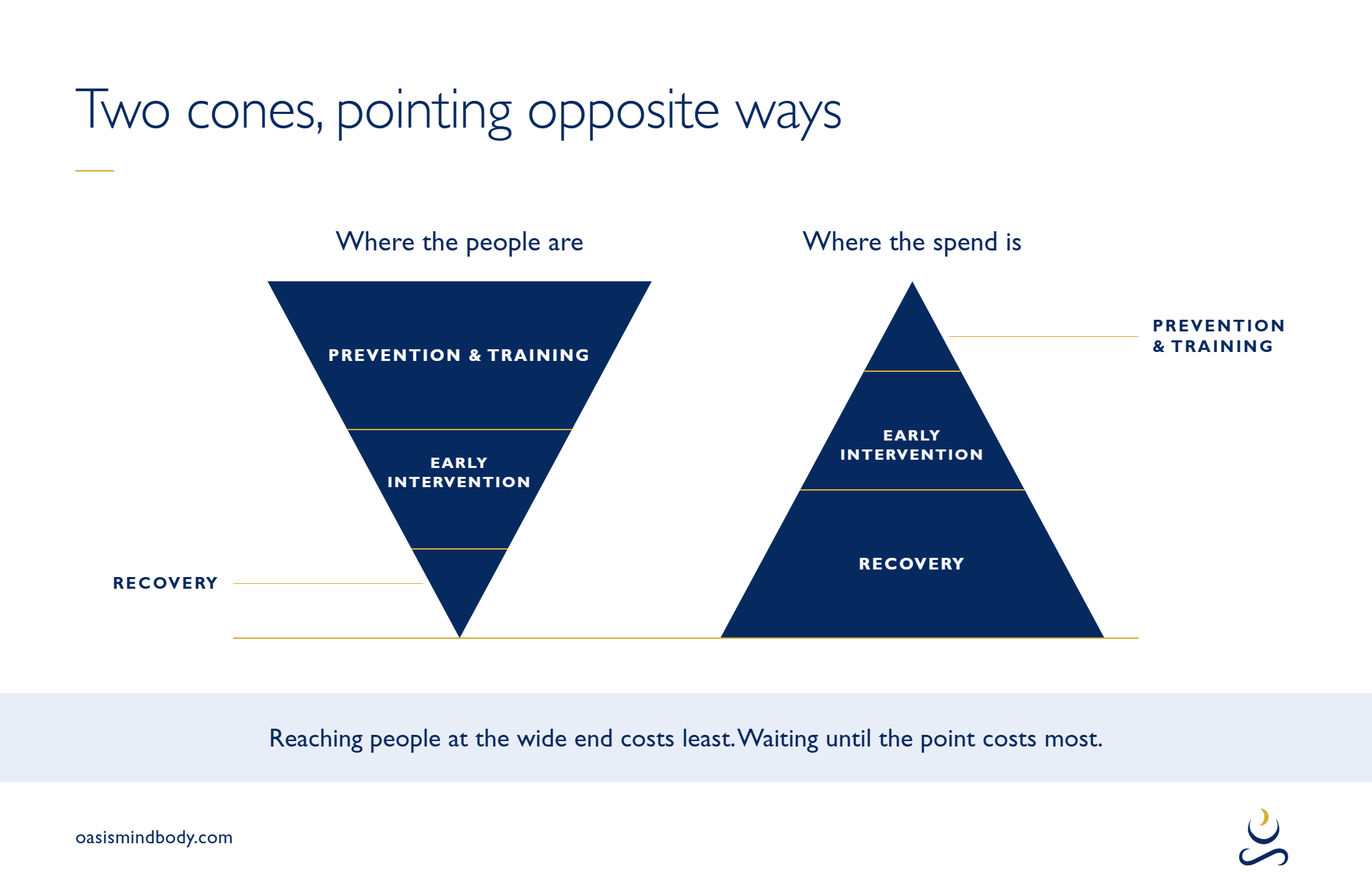
Two cones side by side pointing in opposite directions. The left shows where most people are, widest at prevention. The right shows where most cost is, widest at recovery.
The case for spending earlier
Whilst high-quality research looking at the financial returns of prevention is lacking, a PwC analysis commissioned by Beyond Blue and the National Mental Health Commission found an average return of $2.30 for every dollar invested in effective workplace mental health actions, through reduced absenteeism, improved presenteeism and fewer compensation claims (PwC and Beyond Blue, 2014).
What prevention actually is
Prevention is the layer most often reduced to a training day, so it is worth discussing. There are three things inside it, and they operate at different levels.
Individual habits. Boundaries, genuine psychological detachment from work, sleep, movement, connection. Real, and the layer everyone reaches for first, because it is the easiest to talk about and puts the responsibility on the individual.
Leadership behaviour. Modelling boundaries rather than describing them, checking in with some skill, and building the conditions in which people will speak up. This is where most organisations have the largest gap between what the policy says and what people experience.
Organisational systems. Role clarity, workload that is achievable, recognition, decision rights, and culture designed rather than inherited. This is the highest-leverage layer and the least attended to.
That third layer is what last week's discussion highlighted. If the work itself is producing the harm, through unclear expectations, unrealistic demands or low control, then no amount of individual habit-building will hold, because you are asking people to absorb something the system keeps generating. These are named psychosocial hazards under Australian work health and safety law (and comparable regulations overseas), and they are a design question rather than a support question.
Which is also why prevention cannot be completely delegated to a provider. Systems are set by the organisation, not by whoever delivers the training.
Worth asking
1. If you drew your wellbeing spend as a cone, which way up would it point?
2. Of the three things inside prevention, how many are we actually resourcing, and how many are we hoping people manage on their own?
3. When we say we are investing in prevention, do we mean individual habits, leadership behaviour, or the design of the work (or all three)?
4. What evidence do we have that the base is there, and that people believe it is safe to speak up?
The point
The Cone of Health™ is not a maturity model and there is no level to reach. It is a way of seeing whether the shape of what you spend matches the shape of where your people are.
Most organisations find those two shapes pointing in opposite directions. The useful part is that this is visible, which means it can be measured, discussed at a board table, and changed deliberately rather than by accident.
Next week, the moment someone actually speaks up, and what most organisations do with it.
Stay Curious,
Genevieve
Prevention is three layers deep. The Psychologically Safe Leader builds the middle one.
Opening for pre-sale shortly. Join the waitlist →
This article is general information about work design and leadership capability. It is not legal advice, work health and safety advice, or clinical advice.